![]() |
Stage 1 - The Royal National Park Coast TrackBundeena to Garie Beach |
|
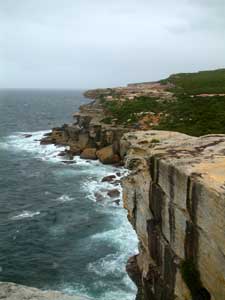
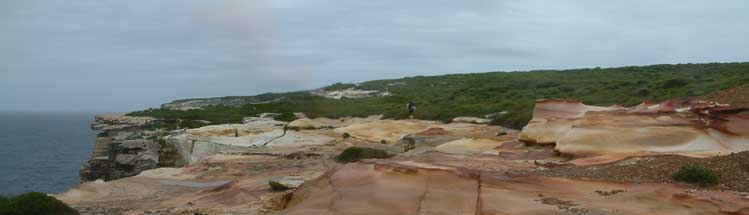
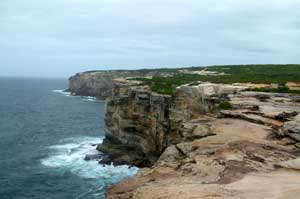
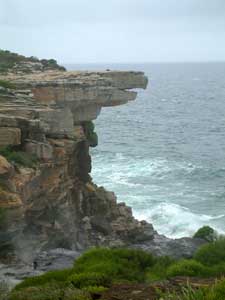
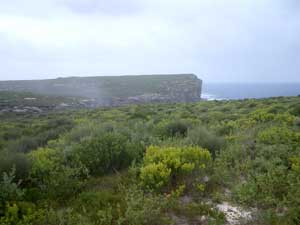
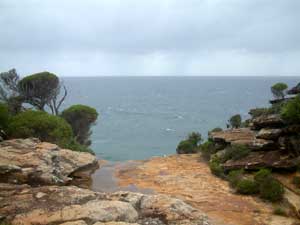
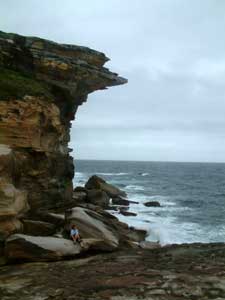
Under a cool overcast sky, we took our first steps from the pier at Bundeena. Our hearts were light, but our packs were heavy. We soon settled down to a regular walking rhythm as we climbed steadily through the streets of the village, and it was not until we reached the entry of Royal National Park and started to follow the sandy track across the low heathlands that the trip seemed really underway. Whenever we passed through heathlands we were accompanied by the twittering of a miscellany of small heathland birds. Soon this gave way to views of the ocean and a soaring sea-eagle greeted us as we reached the cliffs and turned south, directly into the face of a southerly buster – welcome to the South Coast of New South Wales! A test of optimism – to complain “bloody wind” or appreciate experiencing the full wildness of the coast as we followed the path along the cliff edges. We chose the latter and, fuelled by the abundance of negative ions, continued on in fine spirits past the Water-Run, where a stream brings fresh water down a gully eroded into cliffs with splendidly ragged profiles carved by wind and sea. |
..... ![]() Heathland track to the coastal cliffs |
![]() |
|
|
|
|
|
|
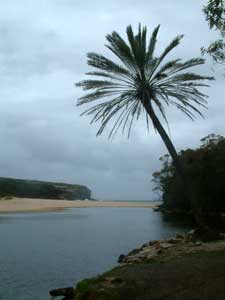
More magnificent cliffs appeared south of Marley before the path deviated inland and descended through taller banksia heath and eucalypts to arrive at the quiet and protected waters of Wattamolla Inlet – a chance to rest, eat and take some respite from the southerly winds. |
Wattamolla Inlet |
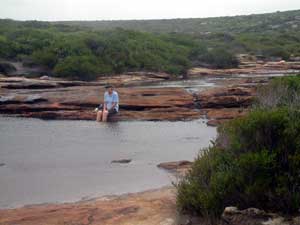
We continued on up and over to the inlet at Curracurrang (where we had camped 4 years earlier), before climbing up to the heathlands of Curra Moors. Here, at Curracurrong, a gentle brook draining from the moors has created a series of shallow pools that invite you to stop and soak tired feet. We accepted. It is also the site of one of nature's phenomena; the upward flowing waterfall. The stream flowed from the pools to the edge of a 40 m cliff, where, instead of falling gently to the ocean, whipped upwards into a fine mist that blew back inland to soak the curious onlooker. Nothing can resist the force of a good Southerly Buster! |
Curra Brook |
|
Eagle Rock |
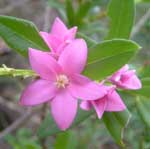
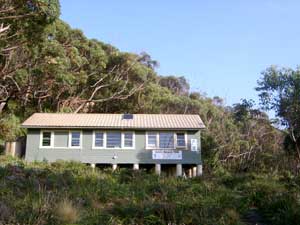
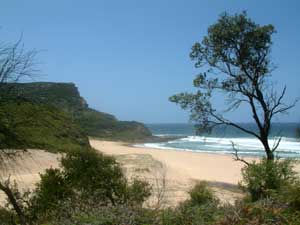
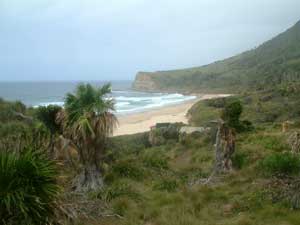
From Curracurrong and the enigmatic profile of Eagle Rock, we steadily climbed up through taller heath, where several species of banksia were just coming in to flower and gymea lilies were sending up their tall flower spikes, to reach the highest point of the walk at North Garie Head (114m). From here, we took in the magnificent view of Garie Beach below and the long stretch of coastal headlands fading southwards into the sea mist. A steep descent down to the beach, short stroll across the sand, and small climb into the forest saw us at our stop for the night; the secluded YHA hut at Garie Beach, in a clearing surrounded by eucalypts, cycads and cabbage palms. |
Curra Moors |
|
Looking south from North Garie Head |
Our sense of achievement was high when we realised that we had probably completed the hardest stage of our entire trip on our first day; 18.6 km with a pack load of 34 kg between us (some lessons in packing efficiency were hard learnt). Here we passed a convivial first night in the pleasant company of fellow walkers, the young doctors and Thomas the lost German, aided by the bottle of red and good food that we had stashed at the hut two days earlier.
|
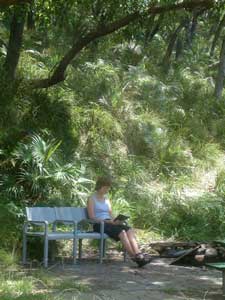
We spent our second day reading and relaxing in the peaceful setting of the hut, as our feet and backs recuperated under the calming influence of the white noise of the bush; the wind rustling in the trees above, the distant sound of the surf and the rise and fall of the song of cicadas. In the evening we strolled back down the track to Garie Beach for a natural spa bath in a rock pool with the surf breaking over us. The trip had started well. |
||
|
![]() Time for a little reading |
|
| Garie Beach to Stanwell Park | |
|
![]() |
|
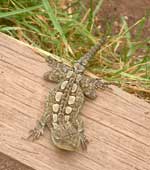
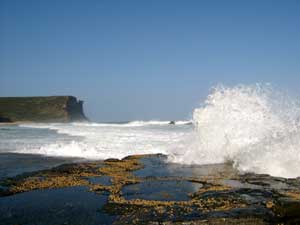
The heathlands of the northern headlands had given way to lomandra and tussock grass as we crossed the communities of beach shacks at Era Beach and Burning Palms. These shacks are heritage listed and reflect the recent history of human usage of this coastal area. The large shell middens at North Era, built by the Dharawal people over thousands of years, reflects a much longer history of human usage that we unfortunately tend to forget. Lunch at Burning Palms was accompanied by several curious skinks and bearded dragons; constant acquaintances along the track and reminders that all humans are but a very recent part of this landscape. |
|
![]() |
|
![]() |
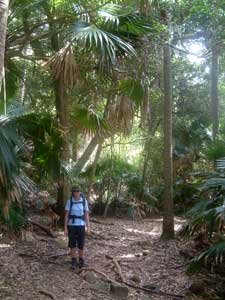
After Burning Palms, the long hard climb to the top of the escarpment began, at first gradually through deeply eroded tracks cut into the lomandra covered slopes, then becoming steeper as we passed through the palm groves and densely forested area known as Palm Jungle. Here is an excellent example of littoral rainforest, whose dark canopy contrasts dramatically to the open heath or grassy headlands and where low hanging woody vines try to trip unwary hikers or snag their packs as they pass. |
We continued on down to the road near Otford, where we finally came to the end of the Coast Track. We had completed this track for a second time and its magnificent and diverse scenery had impressed us just as much now as before. |
![]() |
![]() |
|
|
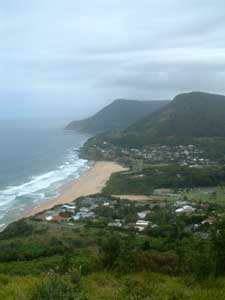
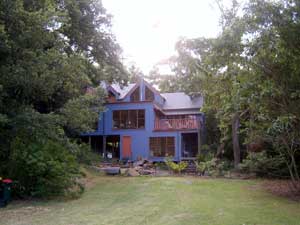
Dreaming over, we rebooted and continued along the road for another 2 km, descending rapidly into the village below. Stanwell Park is a gem, with friendly residents and multilevelled houses perching on steep rainforest slopes above a sandy beach. We checked into one such charming house, the Ocean Blue B & B, had our first hot shower for 3 days, and lounged on the veranda next to a rainforest gully.
|
![]() |
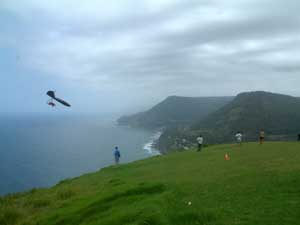
View over Stanwell Park from Bald Hill (left) |
![]() ![]() ![]() ![]() ![]() ![]() ![]() ![]() ![]() ![]() ![]() ![]() |
web design by gang-gang |
![]() |
||||||